

SIGLENT amplía la cartera de generadores de señales de microondas con soluciones de 67 GHz y multicanal
New SSG6089A extends frequency coverage to 67 GHz, while the SSG6M80A series introduces phase-coherent signal generation with two or four channels up to 20 GHz.
As wireless communication systems and high-frequency electronic applications continue to evolve, the requirements placed on RF test and measurement equipment are becoming increasingly demanding. Higher operating frequencies improved spectral purity and the ability to generate multiple precisely synchronized signals are important factors in the development and verification of modern electronic systems. Applications such as 5G/6G research, satellite communications, multi-antenna systems require signal sources that combine frequency coverage, signal quality and flexible configuration.
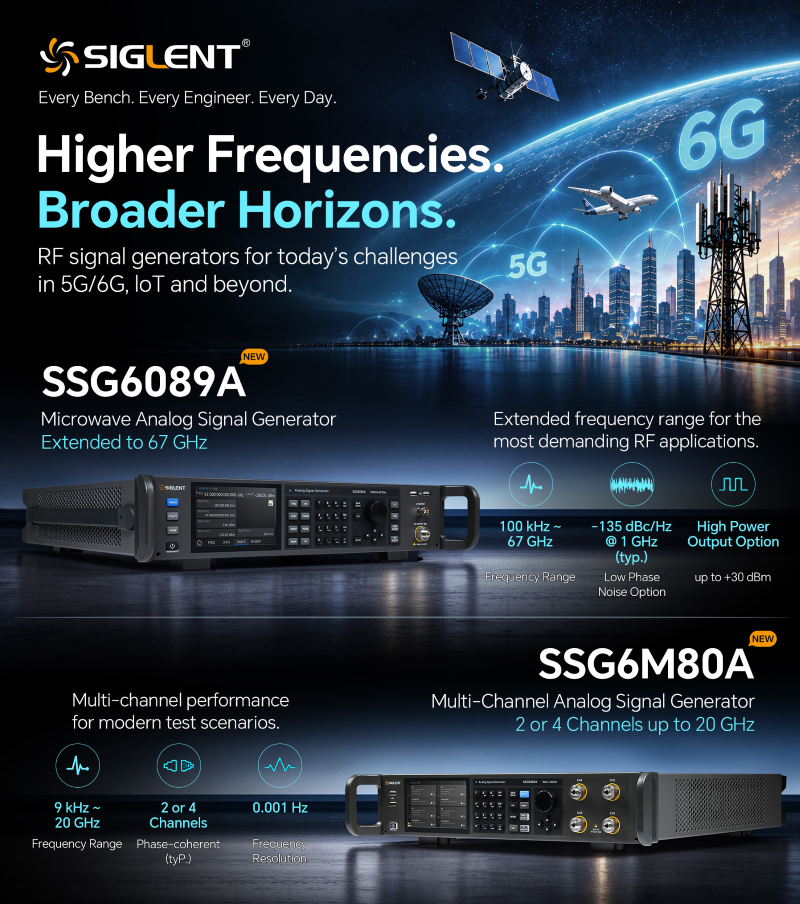
To address these requirements, SIGLENT Technologies is expanding its microwave signal generator portfolio with two product introductions: the SSG6089A microwave signal generator, extending the existing SSG6000A series to 67 GHz, and the new SSG6M80A series, providing two or four phase-coherent RF channels with frequencies up to 20 GHz
SSG6089A – Extending Microwave Signal Generation to 67 GHz
The new SSG6089A expands the frequency range of SIGLENT’s established SSG6000A series, which previously covered frequencies up to 40 GHz. With a frequency range from 100 kHz to 67 GHz, the instrument addresses applications requiring signal generation in higher microwave and millimeter-wave frequency bands.
The SSG6089A provides a frequency setting resolution of 0.001 Hz and supports analog amplitude, frequency and phase modulation. Frequency and amplitude sweeps, optional pulse generation and power meter control enable its use in a variety of RF measurement applications.
In addition to the extended frequency coverage, SIGLENT introduces options for increased RF output power and reduced phase noise. The optional high-power configuration provides output levels of up to +30 dBm in selected frequency ranges, allowing higher signal levels to be generated without additional external amplification in suitable applications.
The optional low-phase-noise configuration improves signal purity, particularly for measurements sensitive to oscillator phase noise. With the SSG6080A-LPH2 option, the series achieves typical phase noise performance of -149 dBc/Hz at a 1 GHz carrier frequency and 10 kHz offset.
These capabilities make the SSG6089A suitable for applications including microwave component characterization, receiver testing and research into next-generation wireless communication technologies.
SSG6M80A – Phase-Coherent Multi-Channel Signal Generation up to 20 GHz
Alongside the extension of the SSG6000A series, SIGLENT introduces the SSG6M80A series of multi-channel microwave signal generators.
The new series is available with two or four RF channels and frequency ranges from 9 kHz to either 13.6 GHz or 20 GHz, depending on the model. Each channel can be configured independently in frequency, amplitude, phase and time delay.
A central feature of the SSG6M80A series is its phase-coherent architecture, supporting phase coherence between channels within a single instrument as well as across multiple synchronized instruments. This enables the generation of multiple RF signals with defined phase relationships, an important requirement in applications such as phased-array systems, beamforming, MIMO testing and multi-channel receiver evaluation.
The generators provide a frequency resolution of 0.001 Hz, phase adjustment resolution of 0.1° and typical phase noise of -135 dBc/Hz at a 1 GHz carrier frequency and 10 kHz offset.
Additional capabilities include analog frequency and phase modulation, optional pulse generation and pulse sequence functionality. An integrated OCXO reference
supports frequency stability, while power meter control facilitates output level adjustment and compensation for external signal path losses.
Designed for Laboratory and Automated Test Environments
Both product families provide USB and LAN interfaces for remote control and integration into automated test systems, with GPIB available as an option. Their 5-inch touchscreen interfaces support local instrument configuration and operation.
With the SSG6089A and SSG6M80A series, SIGLENT addresses two different requirements in modern RF testing: extending signal generation into higher frequency bands and providing multiple phase-coherent signals from a compact instrument platform.
The new generators complement SIGLENT’s existing RF test and measurement portfolio and are intended for use in research and development, system verification and production testing.
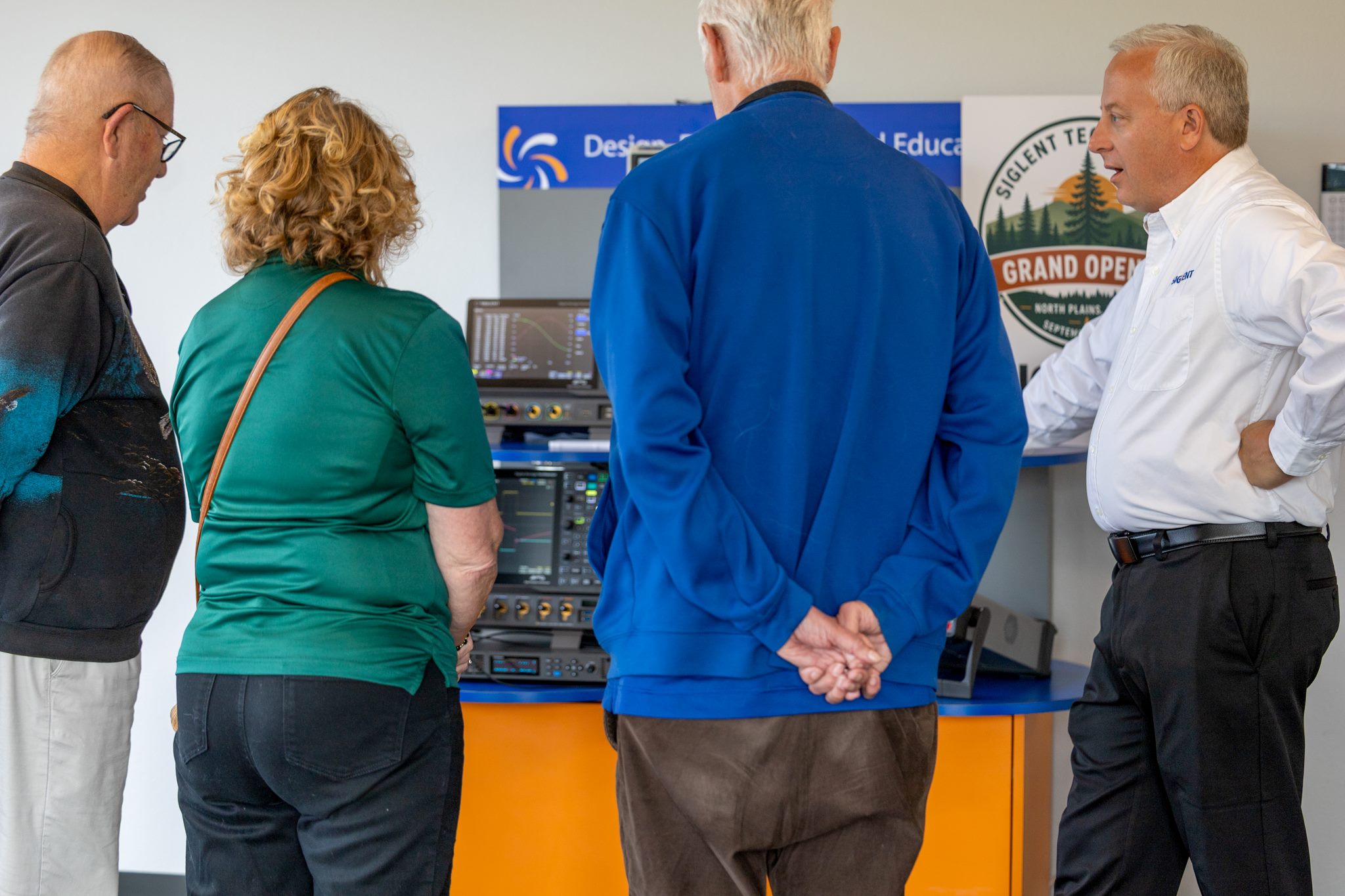
SIGLENT Technologies celebrates the grand opening of its new North American operations center in North Plains, Oregon.
Siglent Technologies continues investing in global capabilities and partnerships that support our customers across the world with the grand opening of our new North American operations center in North Plains, Oregon. Our new North American operations center in North Plains, Oregon includes over 13,000 square feet of space including sales and support offices, a new calibration and service center, and warehousing.

In 2014, Siglent established subsidiaries in the US and Germany followed by Japan in 2022. These regional offices support customers around the world with the quality, capability, and value that Siglent is known for. In 2025, Siglent established a full-process production facility in Penang, Malaysia that manufactures instruments for our global customers.
“This year, our new investment in US capabilities will lay the foundation for years of future growth while providing engineers with access to solutions for their everyday measurement challenges.” says Mike Rizzo, Siglent USA General Manager.

Siglent continues to grow aggressively, providing test and measurement solutions to customers from education to semiconductors. This new operations center will enable us to support even more engineers as we continue a period of strong growth and lay the foundation for an even stronger future.
From oscilloscopes and function generators to spectrum and network analyzers, SIGLENT is a global leader in the design and manufacture of electronic test and measurement instruments that provide high accuracy data, dependable quality, and a smart user interface at prices that deliver value for many years.
For more information, contact:
Michael Rizzo
General Manager
SIGLENT Technologies
29495 NW West Union Road Suite A North Plains, OR 97133
440-398-5800 x111
www.siglentna.com
Siglent Launches SSG3000X Plus Series RF Signal Generators, Delivering Superior Signal Purity and Stability for Precision RF Testing
Siglent launches the SSG3000X Plus Series RF signal generators. Covering a frequency range of 9 kHz to 3.2 GHz with maximum output power of +20 dBm, the series features an optional high-stability OCXO reference source, excellent phase noise, and significantly improved pulse signal fidelity, delivering pure signal output and stable performance.
The SSG3000X Plus comes standard with AM/FM/PM analog modulation, pulse modulation, and USB power meter control. It supports custom pulse sequences and external IQ modulation, and is equipped with a 5-inch capacitive touchscreen. The SSG3000X Plus is well suited for RF component characterization, research and development, manufacturing, education, and maintenance applications, providing a pure, stable, and competitively priced professional RF signal solution.
Una fuente de referencia OCXO de alta precisión opcional mejora significativamente la estabilidad de frecuencia, lo que ofrece una excelente estabilidad de temperatura y una baja tasa de envejecimiento. Esto reduce la desviación de frecuencia causada por las variaciones de temperatura y el funcionamiento a largo plazo, cumpliendo con los estrictos requisitos de precisión de las pruebas prolongadas y las aplicaciones de precisión, mientras que garantiza la fiabilidad a largo plazo de la señal de salida.

El rendimiento del ruido de fase es mejor que –117 dBc/Hz (típico) con una portadora de 1 GHz y un desplazamiento de 20 kHz, y el ruido de banda ancha es típicamente mejor que –153 dBc/Hz con una desviación de 40 MHz. Se consigue una excelente supresión de armónicos y no armónicos en un amplio rango de frecuencias, lo que permite obtener resultados precisos y fiables en pruebas de receptores de alta precisión y mediciones sensibles.

La modulación analógica estándar AM/FM/PM admite fuentes de modulación internas, externas e internas + externas. La modulación IQ externa, disponible en los modelos IQE, se implementa a través de entradas I/Q externas. Cuando se combina con una fuente de banda base SDG6000X, puede generar señales vectoriales como 16QAM y QPSK con un ancho de banda de modulación de RF de 200 MHz, lo que satisface las necesidades de generación de señales de modulación digital complejas.

La modulación por impulsos presenta tiempos de subida/caída típicos inferiores a 15 ns y una relación de activado/desactivado de hasta 68 dBc. La forma de onda de los impulsos, más plana, reduce el riesgo de daños en dispositivos como amplificadores de potencia y módulos T/R. Se admiten los modos de un solo impulso, impulso doble y secuencia de impulsos con hasta 2047 impulsos (opción PT), con ancho y periodo de impulso ajustables con precisión para satisfacer los requisitos de pruebas de equipos de impulsos.

La pantalla táctil capacitiva de 5 pulgadas, compatible con ratón y teclado, ofrece una experiencia de uso intuitiva. Los barridos flexibles por pasos y por lista, que admiten hasta 65 535 puntos, combinados con múltiples modos de activación, permiten realizar barridos rápidos de frecuencia y nivel. El control integrado del medidor de potencia mediante USB compensa automáticamente la pérdida en el cable y la desviación de temperatura. El control remoto por web, junto con las interfaces USB, LAN y GPIB opcional, facilita una integración fluida en entornos de pruebas automatizados.

The SSG3000X Plus series RF signal generators, designed to deliver exceptional signal purity, stability, and versatility for precision RF testing. The new series enhances frequency stability, phase noise performance, and pulse fidelity while offering comprehensive modulation capabilities and intuitive operation. Ideal for RF component characterization, research and development, manufacturing, education, and maintenance, it provides a pure, reliable, and cost-effective professional solution.
SIGLENT Launches DPB6150 & SDP6150 Series High-Voltage Differential Probes
SIGLENT launched two new high-voltage differential probes: DPB6150 Series and SDP6150 Series, further enhancing its product portfolio in the power electronics testing domain. Specifically engineered to tackle the challenges of precise power measurements in high-noise environments, these probes leverage exceptional dynamic range and superior common-mode noise rejection capabilities to significantly improve the accuracy and reliability of signal measurements in high-voltage, high-noise conditions. They will become indispensable tools for engineers during the development and testing of switching power supplies, frequency converters, new energy systems, and various power electronic devices.

The DPB6150 and SDP6150 Series high-voltage differential probes feature a maximum bandwidth of 400 MHz and can measure voltages up to 1500 V. With excellent common-mode noise rejection, high input impedance, and low input capacitance, they enable precise measurement of differential voltage signals and floating signals. Equipped with one-touch zero calibration and audible-visual overload alarms, these probes ensure operational safety and convenience, making them widely applicable to R&D and maintenance of switching power supplies, electronic ballasts, variable-frequency appliances, and other electrical power devices.
DPB6150 & SDP6150 Electric Specifications

SIGLENT Introduces the SDG8000A Series: A New Platform for High-Performance RF and Arbitrary Signal Generation
The new Arbitrary Waveform Generator Combines RF Signal Generation, IQ Modulation and Advanced Sequencing in a Single Platform

SIGLENT Technologies announced the launch of the new SDG8000A Series Arbitrary Waveform Generators, a high-performance signal generation platform designed for advanced RF, wireless communication, semiconductor and high-speed digital applications.
As modern communication and RF systems continue to increase in complexity, developers require signal sources capable of generating wideband, highly dynamic and realistic signals with exceptional fidelity. The SDG8000A Series was developed to address these requirements by combining wideband arbitrary waveform generation, direct RF signal synthesis, IQ vector signal generation and advanced sequencing capabilities in a single instrument platform.
The SDG8000A Series delivers in IQ-Mode output frequencies up to 5 GHz with sampling rates up to 12 GSa/s (interpolation) and 16-bit vertical resolution. Available in two- and four-channel configurations, the new platform provides up to 4 Gpts waveform memory per channel, enabling the generation of long and highly complex signal scenarios for modern RF and communication development.
Using SIGLENT’s TrueArb technology, arbitrary waveforms can be reproduced point-by-point while maintaining waveform detail and low jitter performance. The architecture supports narrow pulse generation down to 250 ps and provides advanced multi-pulse functionality for demanding applications in RF, semiconductor and power electronics development.
A key capability of the SDG8000A Series is its integrated RF and IQ signal generation architecture. The internal digital modulator enables direct RF output up to 5 GHz without requiring external IQ modulation hardware. Combined with the optional SigIQPro software package, the system supports signal generation for modern communication standards including 5G NR, LTE, Wi-Fi, Bluetooth and IoT applications. With modulation bandwidths up to 2 GHz, the platform is well suited for RF front-end validation, receiver testing, amplifier characterization and wireless communication development.
The new series also integrates advanced signal creation capabilities such as multi-tone, chirp and PRBS signal generation, as well as high-speed serial data output up to 1.25 Gbps. Its multi-level sequence architecture enables the creation of highly dynamic and realistic signal environments for burst communication, interference simulation and system-level testing applications.
For synchronized multi-channel systems, the SDG8000A Series provides inter-channel skew below 15 ps together with differential output modes, marker outputs, external clock synchronization and advanced triggering capabilities. These features make the platform suitable for MIMO and other synchronized RF test environments.
The SDG8000A Series further supports LAN connectivity, WebServer-based remote control and integrated SSD storage, enabling efficient integration into automated test systems and modern laboratory environments.
About Siglent:
SIGLENT TECHNOLOGIES began in 2002 with the development of its first digital oscilloscopes. Since then, the company has rapidly expanded its portfolio to cover a broad range of general-purpose electronic test and measurement instruments, including oscilloscopes, signal and function/arbitrary waveform generators, digital multimeters, laboratory power supplies, electronic DC loads, spectrum analyzers, vector network analyzers (VNAs), and RF signal generators.
With the introduction of the Performance Line Series in 2021, SIGLENT further advanced its technical capabilities to address demanding applications in high-performance measurement environments, including solutions reaching into the microwave frequency range up to 40 GHz.
Today, SIGLENT TECHNOLOGIES is a globally recognized provider of electronic test and measurement equipment, combining innovative features, strong engineering expertise, and reliable performance. Headquartered in Shenzhen, China, with international subsidiaries in the United States, Germany, Japan, and Malaysia, SIGLENT supports customers in more than 80 countries worldwide.
SIGLENT is certified according to ISO 9001:2015 and ISO 14001:2015 standards, reflecting its commitment to consistent product quality and responsible environmental management.
SIGLENT Launches 8 GHz Active Differential Probe for High-Speed and RF Applications
SIGLENT introduces the SAP8000D Active Differential Probe, designed to address the challenges of high-speed signal characterization and RF testing.
Featuring 8 GHz bandwidth and ultra-low 300 fF input capacitance, the SAP8000D minimizes probe loading effects while preserving signal integrity in demanding measurement environments. The probe supports both differential and single-ended measurements and provides high common-mode rejection for improved measurement accuracy.
The SAP8000D is well suited for high-speed serial bus validation, signal integrity analysis, and high-frequency circuit debugging across applications including PCIe, DDR, USB 3.0, and Gigabit Ethernet.
To accommodate a wide range of test setups, the probe supports multiple probing methods, including solder-in, handheld, and fixture-based configurations, and is compatible with various probe accessories. This flexible design enables engineers to perform reliable measurements in complex test environments with greater confidence.
By combining high bandwidth, low input capacitance, and versatile connectivity options, the SAP8000D provides an effective solution for next-generation high-speed and RF measurement challenges.


Siglent Releases SigVSA Vector Signal Analysis Software
Siglent officially launched the next-generation SigVSA Vector Signal Analysis Software, bringing professional vector signal analysis capabilities to engineers’ desktops. Compatible with both Windows and Linux operating systems, the software enables comprehensive measurements ranging from basic BPSK signals to complex wideband signals (e.g., UWB, LTE, 5G NR and 4096QAM), delivering an efficient, flexible and unified signal analysis platform for the R&D, testing and manufacturing of wireless communications.

SigVSA offers two application forms: Desktop and Embedded, supporting full-process collaboration from R&D to production. The Desktop version runs on PC, breaking the limitations of instrument hardware and providing a flexible operating environment for complex wideband signal analysis. The Embedded version is deeply integrated into Siglent oscilloscopes and spectrum analyzers (e.g., SDS7000A with the RFA option), enabling high-precision signal analysis without an external PC and simplifying test setups. Both versions share a consistent user interface and measurement engine, ensuring a seamless operational experience.
SigVSA boasts rich measurement functions, currently supports mainstream wireless communication standards including 5G NR/NR-A, 5G NR-NTN, LTE/LTE-A FDD/TDD, Wi-Fi 802.11 a/b/g/n/ac/ax/be, Bluetooth, HRP-UWB and FHSS signals. Signal analysis functions for NB-IoT, GSM, WCDMA, DVB-S2/S2X and FMCW will be launched successively. SigVSA supports synchronized multi-device acquisition and analysis, allowing remote control and waveform capture for up to 32 instruments simultaneously. Equipped with remote management capabilities, it enables one-click device configuration switching, automatic connection record saving, and configuration synchronization from the host to the analyzer. Its multi-window display and custom layout features further enhance the efficiency of parallel multi-task analysis.
SigVSA provides comprehensive local analysis capabilities, supporting direct import and analysis of raw waveform files from analyzers for flexible offline signal evaluation. Additionally, SigVSA enables remote signal analysis and debugging on a PC, allowing simultaneous control of multiple instruments to acquire and process signals, without relying on the instrument’s vector analysis options, expanding its applicability and device compatibility. With SigVSA, engineers can tackle various signal analysis challenges more freely and efficiently.
Siglent has launched attractive promotional policies and flexible licensing plans, greatly lowering the barrier to use. From June 22, 2026 to June 22, 2028, purchasing an SDS7000A oscilloscope with the RFA option will receive full-feature of Embedded SigVSA free of charge, enabling complete high-end signal analysis functionality. Furthermore, the SigVSA PC version is available for free download, with the base version including three core functions: Spectrum and IQ Analysis (SIGV-VSAA1), Digital Modulation Analysis (SIGV-VSAD1), and Custom OFDM Modulation Analysis (SIGV-VSAO1). TRY BEFORE YOU BUY! Confident in its performance, SigVSA offers 30 free trials for each function, enabling you to evaluate its powerful analysis capabilities risk-free. Start testing today to find your perfect solution.

Click To Check the Promotion Details
The release of SigVSA enriches Siglent’s signal analysis platform. Together with Siglent signal generation software SigIQPro, it forms a complete solution from signal generation to analysis, supporting engineers in accurately simulating real-world communication scenarios and enabling a smooth transition from traditional tools to a modern, scalable platform. Going forward, Siglent will continue to iterate SigVSA’s features, expand its signal analysis coverage, and provide higher-quality solutions for wireless communication testing.
Siglent Launches SNA5000X-E Vector Network Analyzer
Compact, Cost-Effective 6.5 GHz VNA Delivering High Performance for R&D and Production

Siglent Technologies officially announces the release of the SNA5000X-E Vector Network Analyzer, a compact and cost-effective solution designed to meet essential RF testing requirements without compromising performance. Covering a frequency range from 9 kHz to 6.5 GHz and delivering a typical dynamic range of 125 dB, the SNA5000X-E provides accurate, reliable measurements for R&D, education, and production environments.
Positioned as an entry-level model within the SNA5000 series, the SNA5000X-E retains the core performance architecture of the SNA5000A family while offering enhanced cost-effectiveness for standard vector network analysis applications. It supports 1 Hz frequency resolution, adjustable IF bandwidth from 1 Hz to 10 MHz, and an output power range from –40 dBm to +10 dBm. With its 125 dB typical dynamic range, the instrument maintains excellent measurement stability and accuracy even in complex RF test scenarios.

The SNA5000X-E supports comprehensive S-parameter and differential measurements, along with integrated time-domain analysis, enhanced time-domain analysis, and spectrum analysis functions. These capabilities enable engineers to evaluate frequency-domain characteristics, analyze impedance discontinuities, and quickly locate faults within devices under test. A built-in eye diagram function further supports high-speed signal integrity analysis, improving debugging efficiency during development.

To address fixture-induced measurement errors commonly encountered in RF testing, the SNA5000X-E incorporates automatic fixture removal, port extension, de-embedding, and impedance conversion functions. These tools effectively compensate for cable delay and loss, minimizing systematic errors and ensuring high confidence in measurement results.
Designed for modern laboratories and production lines, the SNA5000X-E features a compact form factor with an instrument depth of only 12.6 cm and a weight of less than 5.4 kg. This significantly reduces workspace requirements compared to traditional network analyzers. The instrument is equipped with a 12.1-inch touchscreen that supports multi-window display and multiple data formats, creating an intuitive and efficient operating experience.
For production and automated test environments, the SNA5000X-E offers one-click filter characteristic analysis to quickly obtain key parameters such as insertion loss and bandwidth. It also supports custom formula operations and remote control via SCPI and WebServer, enabling seamless integration into automated systems and helping standardize and streamline testing workflows.
By returning to the fundamentals of vector network analysis, the SNA5000X-E combines essential performance, intelligent operation, and compact design in an economical solution. It provides a reliable, one-stop platform for applications ranging from R&D validation to batch quality inspection, enabling engineers to achieve professional RF measurement capability with optimized investment.
SIGLENT Launches New 8 GHz Digital Oscilloscope!
July 10, 2025 — SIGLENT has unveiled the enhanced SDS7000A/AP models, building on the success of its SDS7000A high-resolution digital oscilloscope series. The new models now feature bandwidth up to 8 GHz, a high-resolution 12-bit ADC, maximum 20 GSa/s sampling rate per channel, and a maximum memory depth of 2 Gpts/ch. New capabilities include 2.5G/5G/10GBase-T Ethernet Electrical Compliance Testing, MIPI-DPHY protocol analysis, Real-Time Spectrum Analysis (RTSA), Digital Down-Conversion (DDC), and upgraded CAN XL decoding.

2.5G/5G/10GBase-T Ethernet Electrical Compliance Testing
The upgraded SDS7000A series now supports full electrical compliance testing for 2.5G/5G/10GBase-T Ethernet, including critical parameters such as output drop, transmitter timing jitter, power spectral density, and MDI return loss. These features help ensure devices meet IEEE standards. Engineers can automatically generate IEEE 802.3-2018-compliant compliance test reports in HTML, XML, or PDF formats, including pass/fail status, threshold values, measured results, margin analysis, and waveform displays. This visually rich and data-driven reporting streamlines troubleshooting and product optimization.

MIPI-DPHY Compliance Testing
The SDS7000A series also supports MIPI-DPHY compliance analysis based on the CTS 1.0 specification. The oscilloscope captures HS-TX and LP-TX signaling on both data and clock lanes using its 12-bit ADC and ≥4 GHz bandwidth, combined with 5 GHz active differential probes. Eye diagram functionality is integrated for evaluating signal integrity, with automated configuration and report generation.

Real-Time Spectrum Analysis (RTSA)
Equipped with RTSA and digital down-conversion (DDC) technologies, the SDS7000A supports up to 1 GHz Real-Time analysis bandwidth. Advanced display modes include density plots, spectrum monitoring, and 3D visualizations. Compared to traditional superheterodyne spectrum analyzers, the SDS7000A offers higher bandwidth and faster signal acquisition — ideal for capturing transient events in 5G NR, 4G LTE, and Wi-Fi.

Integrated Vector Signal Analysis (SigVSA)
The SDS7000A features SigVSA vector signal analysis software, allowing direct signal analysis from DDC output without external equipment. It supports demodulation of signal types ranging from basic BPSK to complex wideband signals, such as those in 4G LTE, 5G NR, IEEE 802.11b/a/g/n/ac/ax/be standards, and 4096QAM. Both real-time and offline waveform analysis are supported, providing flexibility for laboratory and post-processing workflows.

Enhanced CAN XL Decoding Support
The SDS7000A series oscilloscopes provide comprehensive CAN protocol testing capabilities, with full support for CAN XL decoding in addition to CAN/CAN FD, enabling seamless coverage of automotive bus systems from low-speed diagnostics (10 kbps) to high-speed domain control (20 Mbps). The instrument supports both low-power and high-speed modes, making it well-suited for automotive and industrial control applications. The oscilloscope features 16 total channels (4 analog and 12 digital) for synchronized decoding and comprehensive fault analysis, including collision detection and signal reflections.

The SDS7000A also supports Wake-on-LAN (WoL), enabling users to remotely power up the instrument via Ethernet — ideal for automated test environments where physical access is limited.
With these cutting-edge features, the SDS7000A/AP oscilloscopes provide a powerful and versatile platform for engineers in data centers, wireless communications, consumer electronics, and automotive applications.
Compact All-in-One Handheld Signal Analyzer for 5G/LTE Field Testing
Siglent introduces the SHA860A series, a next-generation handheld signal analyzer designed to revolutionize 5G/LTE field testing. Combining spectrum analysis, vector network analysis, and cable/antenna testing into a single portable platform, the SHA860A delivers unparalleled versatility for base station deployment, maintenance, and on-site troubleshooting. Key specifications include a 9 kHz to 7.5 GHz frequency range (usable from 5 kHz), 110 MHz real-time analysis bandwidth, and advanced capabilities such as 5G NR/LTE OTA testing, real-time spectrum analysis, pulse analysis, IQ data acquisition, and GPS-synchronized indoor/outdoor mapping and so on.

5G NR OTA Measurement
During 5G base station deployment, operators require precise validation of network quality and beam performance. The SHA860A’s 5G NR OTA mode demodulates signals to extract key parameters, including frequency, physical cell identity (PCI), SSB index, frequency error, and error vector magnitude (EVM) for the SSB portion, visualized via constellation diagrams. This functionality is vital for optimizing 5G Non-Standalone (NSA) deployments, ensuring seamless coordination between LTE and 5G networks.

LTE FDD/TDD OTA Measurement
The LTE OTA testing feature provides comprehensive demodulation metrics such as PCI, sector ID, cell group, frequency error, time offset, synchronization status, and power levels (PSS/SSS/CRS/PBCH), alongside EVM measurements and constellation diagrams. By analyzing signal quality, channel performance, and interference across multiple cells, technicians can implement targeted strategies to enhance network efficiency and user experience.

Real-Time Spectrum Analysis
With a 110 MHz real-time bandwidth and 300,000 FFT/s processing speed, the SHA860A captures transient signals as short as 3.51 µs at 100% Probability of Intercept (POI). Advanced tools like frequency mask triggering (FMT), Density, 3D, Spectrogram, and Power vs. Time (PvT) displays enable multi-dimensional analysis of complex signals, ideal for interference hunting and spectrum monitoring in dynamic 5G environments.

Cable and Antenna Test
Component faults compromise base station performance, leading to coverage gaps and signal strength degradation. The SHA860A streamlines maintenance with rapid single-port cable loss, return/insertion loss, VSWR, and distance-to-fault measurements. An optional upgrade adds 1-Path 2-Port vector network analyzer functionality, supporting S11/S21 testing, Smith chart displays, and a remarkable 114 dB dynamic range for precise amplitude/phase response analysis.

Pulse Profile Analysis
The pulse analysis function featuring 10,001 measurement points to evaluate power, pulse transitions, and signal characteristics using multiple detection modes (positive/negative peak, sample, average, and conventional). This ensures rigorous validation of RF device performance in real-world conditions.

Indoor/Outdoor Mapping
Beyond base station testing, identifying 5G/LTE coverage in specific areas is crucial. The indoor/outdoor mapping feature enables technicians to locate base stations, track antenna orientation/height, and identify weak coverage or high-interference zones. With data logging, playback, and ±0.01 ppm accuracy post-GPS lock, it simplifies network optimization in both indoor and outdoor environments.

IQ Data Acquisition
Signal and spectrum analyzer with IQ data acquisition function is a common signal acquisition tool. Equipped with 1 GB RAM, 300 MHz sample rate, and 110 MHz bandwidth, the SHA860A provides a powerful combination of specifications, functions and portability for users collecting data in the field environment. Users can transmit and store IQ data via USB or LAN for offline analysis, so as to reproduce signals and visualize spectrum details with unmatched clarity.

The Siglent SHA860A consolidates critical 5G/LTE testing tools into a single handheld device, empowering technicians to validate beam performance, detect interference, and optimize networks with precision. Its excellent real-time bandwidth, GPS mapping, and comprehensive OTA capabilities accelerate deployments while ensuring reliable service delivery, enabling technicians to tackle complex field challenges with unmatched precision and convenience.