
Vector Signal Analysis Software

SigVSA

SigVSA

SigVSA

SigVSA

Created with Pixso.

Product Introduction

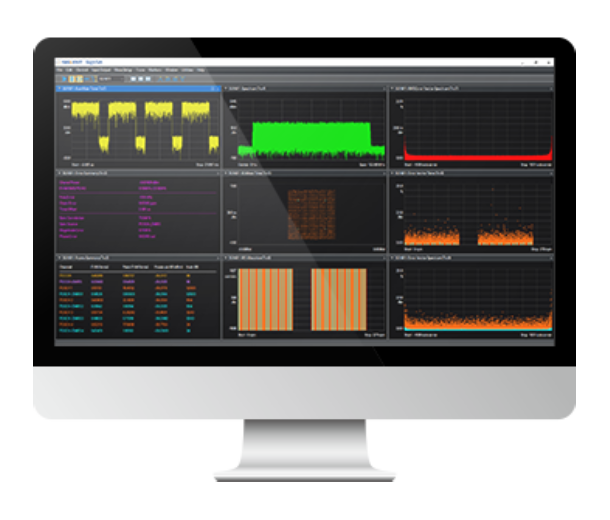
SigVSA Vector Signal Analysis software brings professional vector signal analysis capabilities to engineers’ desktops. It supports both Windows and Linux operating systems, enabling users to repeatedly analyze signals and quickly identify issues. It covers a comprehensive range of measurement requirements, from basic BPSK to complex wideband signals such as FHSS, IQA, UWB, DMA, OFDM, 4G LTE, 5G NR, IEEE 802.11b/a/g/n/ac/ax/be, and 4096QAM.

Key Features

  • Offline waveform data analysis on PC
  • Multiple IQ data formats
  • Supports the maximum 2G analysis bandwidth of the specified signal.
  • Support general OFDM signal analysis
  • Signal analysis supporting cellular protocols such as 4G LTE and 5G NR.
  • Support a variety of general modulation signal analysis.
  • Support WLAN standard signal analysis such as IEEE802.11b/a/g/n/ac/ax/be.
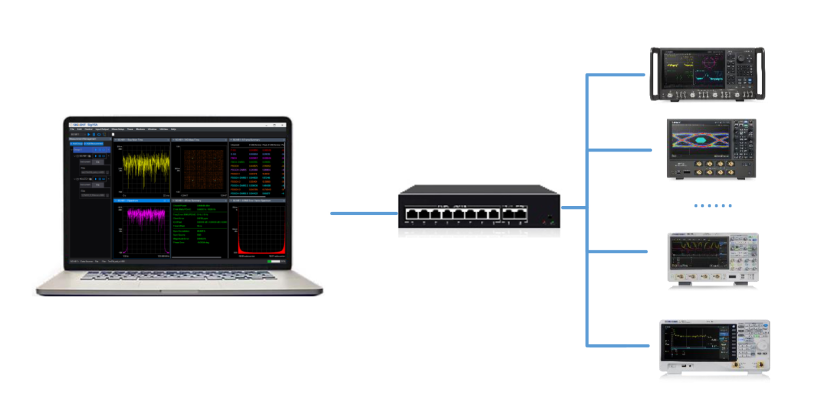
  • Support online control of multi-instrument acquisition, and obtain waveform data to PC for analysis.
  • Support simultaneous control of multiple instruments and equipment for parallel vector analysis, and multiple applications can be displayed independently, which is convenient and clear.
Product advantage

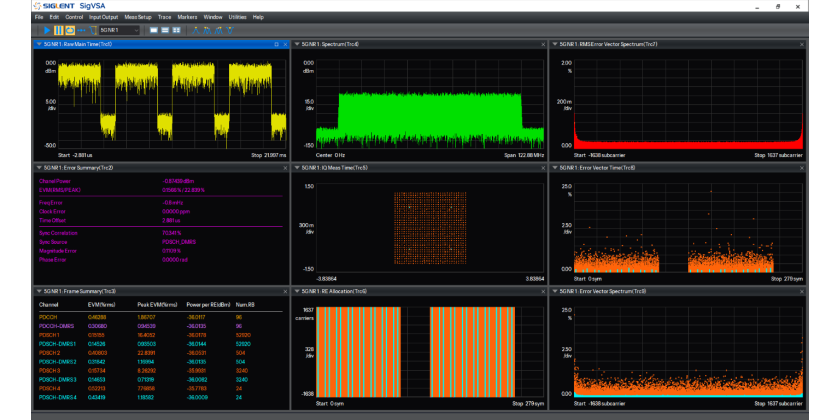
5G NR|NTN

  • Supports frequency bands FR1, FR2-1, and FR2-2, with a maximum bandwidth of 2 GHz;
  • Quick setup of Test Model, DL FRC, UL FRC, UL RMC, and other RF conformance test signals;
  • Supports demodulation of signals such as SSB, PDCCH, PDSCH, CSI-RS, PUCCH, and PUSCH;
  • Complies with 3GPP protocol standards for equalization, tracking, and EVM window configuration;
  • Supports displays: Time Domain (Raw Main Time), Spectrum, Constellation (IQ Meas Time), Resource Element Allocation (RE Allocation), Error Vector, RMS Error Vector, Error Summary, and Frame Summary;
  • Supports measurements of EVM, Frequency Error, Clock Error, Magnitude Error, Phase Error, and other metrics;
  • Supports AM-AM and AM-PM measurements.

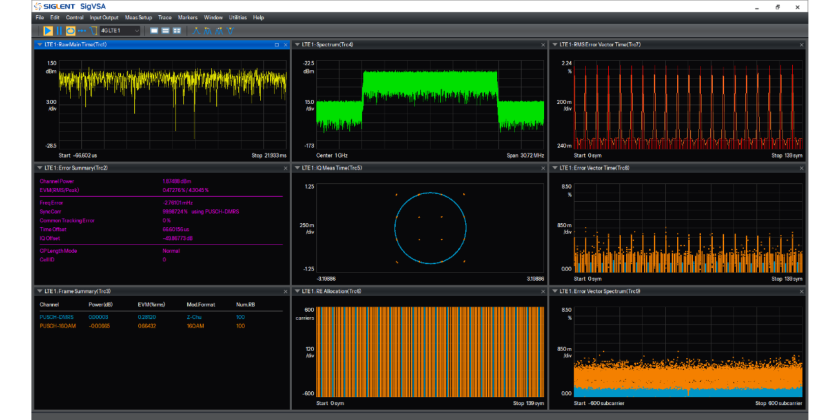
LTE/LTE-A FDD/TDD

  • Quick setup of Test Model, DL FRC, UL FRC, UL RMC, and other RF conformance test signals;
  • Supports demodulation of signals such as PSS/SSS/PBCH/CRS, PDCCH, PDSCH, PHICH, PUCCH, and PUSCH;
  • Complies with 3GPP protocol standards for equalization, tracking, and EVM window configuration;
  • Supports displays: Time Domain (Raw Main Time), Spectrum, Constellation (IQ Meas Time), Resource Element Allocation (RE Allocation), Error Vector, RMS Error Vector, Error Summary, and Frame Summary;
  • Supports measurements of parameters such as EVM, Frequency Error, Clock Error, RSSI, RSTP, and TAE.

WLAN 802.11 b/g/a/n/ac/ax/be

  • Supports IEEE 802.11 b/g/a/n/ac/ax/be protocol standards;
  • Supports full bandwidth modes of 20/40/80/160/320 MHz;
  • Supports demodulation of signals with full modulation orders: BPSK, QPSK, 16QAM, 256QAM, 1024QAM, and 4096QAM;
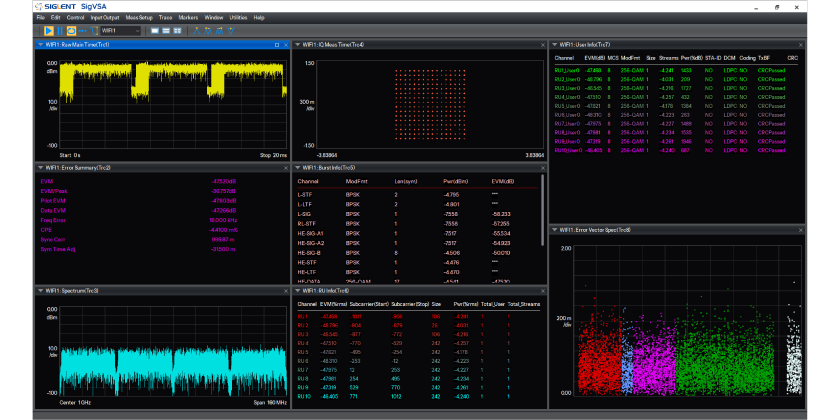
  • Provides key metric measurements such as EVM (Error Vector Magnitude), Frequency Response, Constellation Diagram, and Sync Correlation, displaying detailed RU allocation and user information in multiple colors.

Custom IQ

Flexible and diverse modulated signal analysis:

  • 2ASK, 4ASK, 8ASK, 16ASK
  • 2FSK, 4FSK, 8FSK, 16FSK
  • MSK, GMSK
  • BPSK, DBPSK, QPSK, OQPSK, DQPSK, pi/4-DQPSK, 3pi/4-QPSK, 8PSK, D8PSK, pi/8-D8PSK, 3pi/8-8PSK
  • 16QAM, 32QAM, 64QAM, 128QAM, 256QAM, 512QAM, 1024QAM, 4096QAM, Pi/4-16QAM, -pi/4-32QAM
  • 16APSK, 32APSK

Provides multiple view options, including Constellation (IQ Meas/Ref Time), Spectrum, Error Vector, Magnitude Error, Phase Error, Error Summary, and Demod Bits;

Supports flexible Burst Search and Sync Pattern for measuring burst signals and complex composite signals;

Supports segmented demodulation for handling multi-modulation signals;

Supports adaptive equalization for exploring performance limits.

Custom OFDM

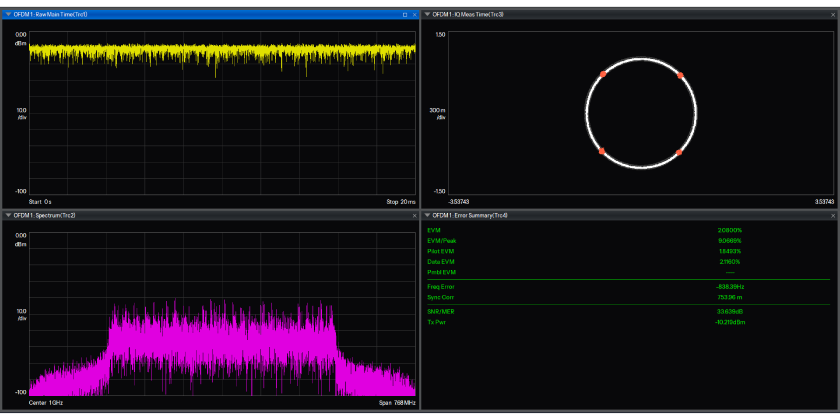
  • Measures custom or proprietary standard OFDM signals;
  • Built-in template parameters for 3GPP LTE and WLAN 802.11a;
  • Supports free definition of Preamble, Pilots, and modulation schemes;
  • Provides flexible equalization and tracking configuration.

HRP-UWB

  • Analysis of HRP (High Rate Pulse Repetition Frequency) UWB (Ultra-Wideband) signals based on IEEE 802.15.4/4z standards;
  • Adapts to all channels, bandwidths, modulation schemes, and physical modes, including Non-HRP-ERDEV (802.15.4), ERDEV-BPRF, and ERDEV-HPRF (802.15.4z);
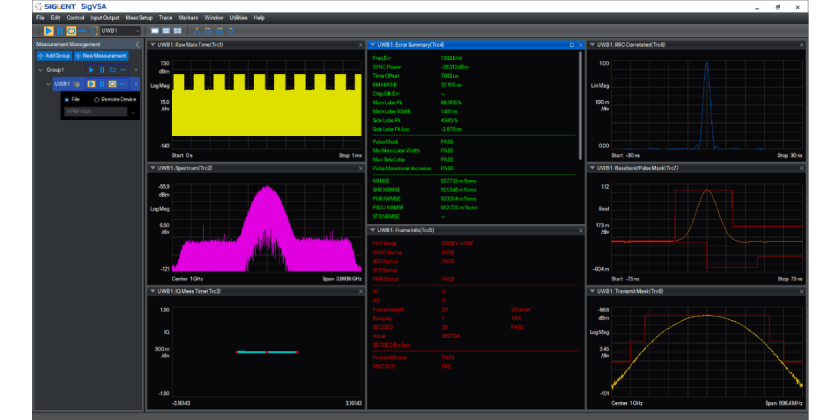
  • Supports rapid RF specification measurements such as BaseBand Pulse Mask verification, Transmit Mask verification, and RRC Correlated Trajectory;
  • Supports measurements of Frequency Error, Power, Time Offset, and NRMSE metrics;
  • Supports correctness detection of protocol frame fields (SYNC, SFD, PHR, PSDU) and verification of PHR+PSDU decoding and CRC.

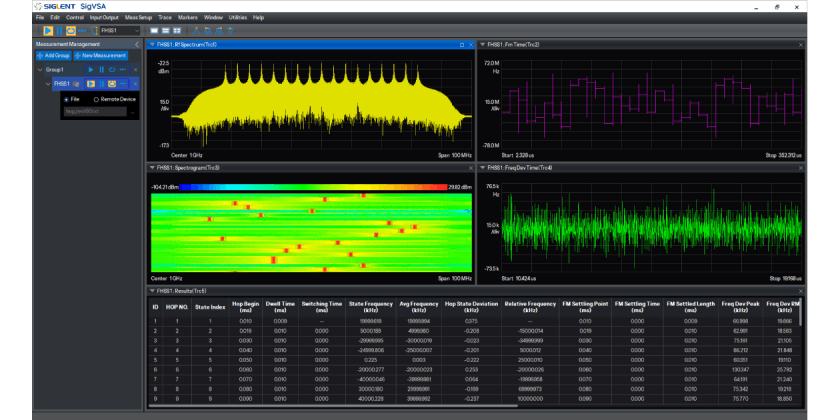
Frequency-Hopping Signal Analysis

  • Analyzes fast frequency-hopping pulse signals in automotive and other fields;
  • Frequency hopping signal measurements: Dwell Time, Settling Time, Switching Time, Frequency Deviation, Phase Deviation, Power, and Power Ripple;
  • Supported views: RF Spectrum, FM Time, Frequency Deviation vs. Time, Spectrogram, and Results Summary.

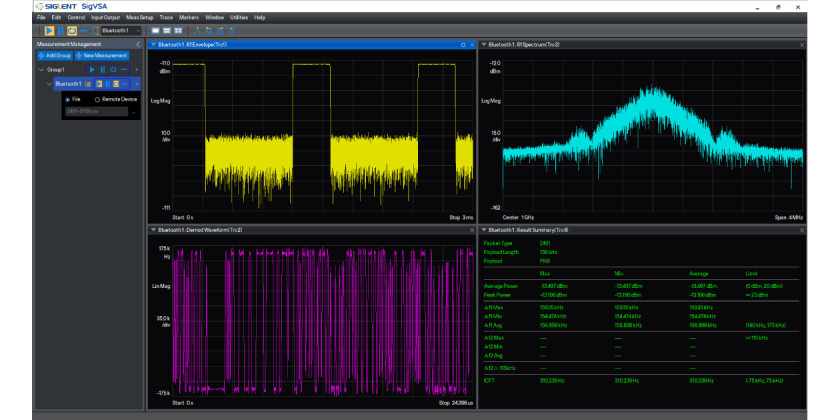
Bluetooth

  • Supports Bluetooth® 5.3 Basic Rate (BR), Enhanced Data Rate (EDR), and Low Energy (LE);
  • Supports fully automatic detection of rate types and packet types;
  • Measurement process complies with Bluetooth® Test Suite; supports measurements of Carrier Frequency Offset, Carrier Frequency Drift, ICFT, DEVM, Delta Frequency, BER, and other metrics;
  • Supported views: RF Envelope, RF Spectrum, Demodulated Waveform, and Result Summary.

Configure your instrument

Add to Compare ModelsOption Description Price (Tax Not Included)  

Resources

Hide Created with Pixso.